Finding genuinely useful quick fitness routines for people traveling for work often requires cutting through advice that assumes access to a hotel gym that is either excellent or actually exists, enough time in the schedule to treat fitness as a distinct daily priority, and enough energy after a full day of client meetings or conference sessions to perform at a level that produces meaningful results. Frequent business travelers deal with none of these assumptions reliably and all of them occasionally. The fitness strategies that actually survive the road are built around constraints rather than around ideal conditions, and the gap between what works in theory and what works in a fourteen by sixteen foot hotel room at 10pm after a delayed flight and a working dinner is larger than most fitness advice acknowledges.
Understand Why Frequent Travel Destroys Standard Fitness Routines
Before any strategy lands usefully, understanding the specific mechanisms by which frequent work travel dismantles standard fitness routines makes the solutions more intelligible and more motivating than treating each failed attempt as a discipline problem.
Standard fitness routines depend on environmental consistency for their automatic execution. The gym is always there. The equipment is always available. The time slot is protected by a schedule that repeats. Work travel destroys all three simultaneously. The environment changes every two to four days. Equipment varies from a fully equipped gym to a single stationary bike in a converted closet to nothing at all. The schedule is controlled by clients, conference organizers, and flight times rather than personal preference. This is not a willpower problem. It is an environmental design problem, and the solution is designing fitness strategies that work across the variable environments of frequent travel rather than requiring the consistent environment that travel specifically eliminates.
1. Build a Hotel Room Routine That Requires Exactly Zero Equipment
The hotel room routine is not a fallback for when the gym is bad. For frequent business travelers, it is the primary fitness strategy, and building it to be genuinely effective rather than merely better than nothing changes both the results it produces and the consistency with which it gets executed.
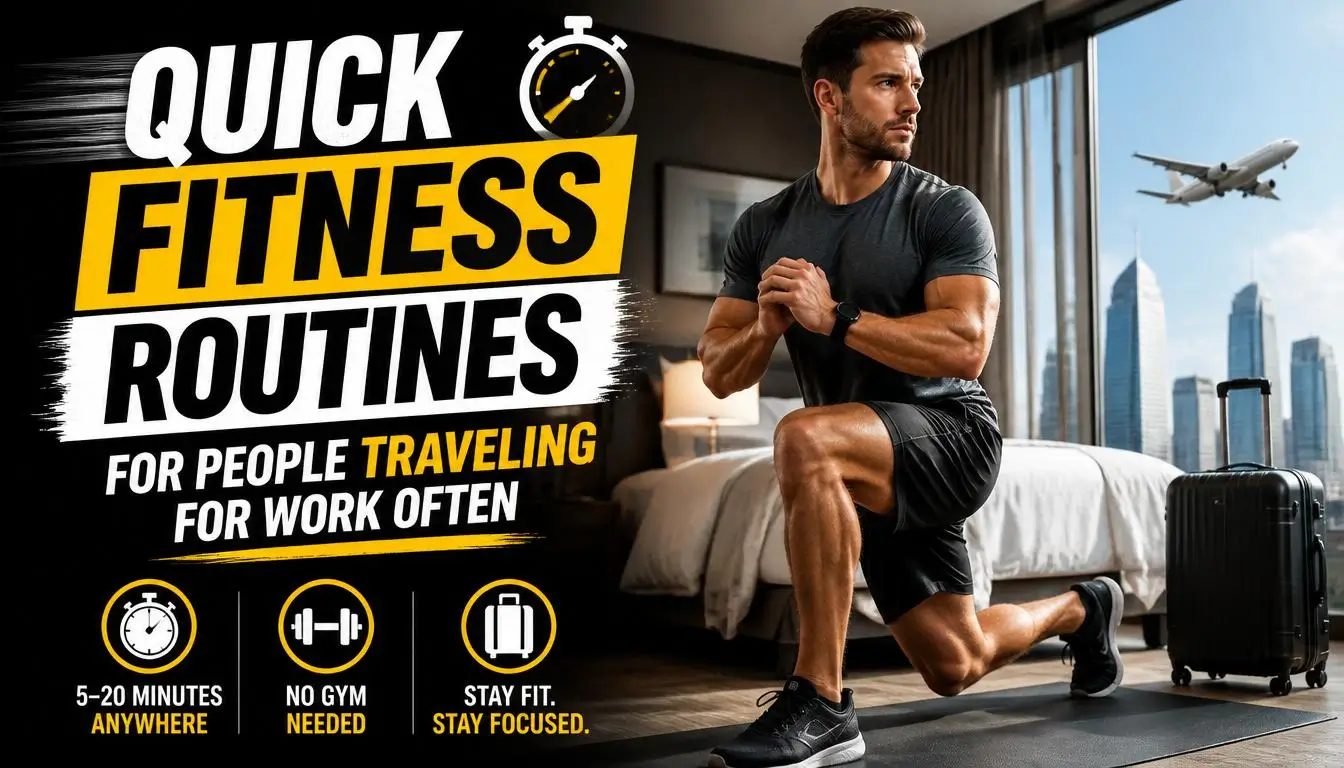
Twenty minutes of circuit training in a hotel room covering the fundamental movement patterns produces genuine fitness stimulus. The circuit that covers the most ground in the least time combines five exercises performed for forty seconds each with twenty seconds rest, repeated three times: bodyweight squats, push-up variations, reverse lunges, plank holds, and mountain climbers or jumping jacks for cardiovascular demand. This circuit requires no equipment, no floor space beyond what a hotel room reliably contains, produces no noise that disturbs neighboring rooms if jumping is modified to step-touch alternatives, and can be performed in work clothes if the session happens between meetings rather than requiring a wardrobe change. The critical feature of this routine is that it is completely predetermined. The frequent traveler who arrives at a hotel at 9pm needing to decide what exercise to do has already lost the battle with fatigue and competing priorities. The traveler who arrives knowing exactly what they’re doing and how long it takes executes it with a fraction of the activation energy.
2. Use the Hotel Gym Strategically When It’s Actually Good
Hotel gym quality ranges from genuinely excellent facilities that rival commercial gyms to a single broken treadmill in a room that smells like the 1990s, and having a predetermined approach for each quality tier rather than trying to improvise removes the decision fatigue that produces a workout consisting of ten minutes on the treadmill and abandonment.
For excellent hotel gyms with free weights, cable machines, and cardiovascular equipment, use the opportunity for compound barbell or dumbbell strength training that’s difficult to replicate in the room. Deadlifts, bench press, rows, and overhead press with actual weight provide stimulus that bodyweight work can’t fully match and deserve priority when the equipment to perform them is available. For mediocre hotel gyms with limited equipment, use dumbbells for compound movements and machines for the patterns dumbbells don’t cover efficiently. Dumbbell Romanian deadlifts, dumbbell floor press if a bench isn’t available, and seated cable rows or machine rows cover the fundamental patterns adequately. For genuinely bad hotel gyms, treat them as cardio-only facilities and do the strength work in the room with bodyweight and any bands you’ve carried. The Marriott, Hilton, and Hyatt chains have invested more consistently in gym quality than budget chains, and booking within these programs when company travel policy allows produces better average gym access without upgrading room category.
3. Pack a Fitness Kit That Weighs Under Two Pounds
The fitness equipment that frequent business travelers carry needs to meet a specific constraint set that most gym bag content fails: it must weigh almost nothing, pack flat in a corner of a carry-on, require no assembly, and provide meaningful training variety despite its minimal form factor.
The kit that meets all of these constraints contains three items.
A set of three loop resistance bands in light, medium, and heavy resistance from Fit Simplify or WOD Nation, which collectively weigh under four ounces and provide lower body, core, and some upper body training stimulus. A TRX suspension trainer or a door anchor with short handles, which weighs approximately one pound and converts any hotel room door into a pulling exercise station, addressing the pulling movement pattern that is the most difficult to train without equipment in a travel context. A jump rope from the CrossRope or RPM Sport brand, which weighs under six ounces, collapses to the size of a handful, and provides the highest caloric expenditure per minute of any portable equipment available. The complete kit weighs under two pounds, fits in a packing cube the size of a paperback book, and covers every fundamental movement pattern including the pulling and cardiovascular elements that bodyweight alone cannot address adequately.
4. Use the EMOM Format for Time-Efficient Training
The EMOM, Every Minute On the Minute, is the training format that most efficiently packages meaningful fitness stimulus into the irregular and compressed time windows that frequent business travel produces, and understanding it converts any available fifteen to twenty minute window into a structured, effective workout rather than an aimless collection of exercises.
An EMOM works as follows: at the start of each minute, perform a predetermined number of repetitions of a specific exercise, then rest for whatever time remains in that minute before the next exercise begins. A fifteen-minute EMOM for a hotel room might look like this: minute one contains fifteen bodyweight squats, minute two contains ten push-ups, minute three contains twelve reverse lunges per leg, minute four contains a thirty-second plank hold, minute five contains twenty jumping jacks or step-touches, and minutes six through fifteen repeat the five-exercise sequence twice more. The EMOM format is self-scaling because slower performers rest less while faster performers rest more, but both groups complete the same workout in the same time. It also eliminates the between-exercise decision-making that consumes a surprising amount of time in unstructured workout sessions. The Timer+ app and Seconds interval timer both run EMOM protocols on any smartphone with no subscription required.
5. Treat the Airport as a Fitness Opportunity Rather Than a Waiting Room
The airport, which frequent business travelers spend more time in than any other non-work, non-hotel environment, contains fitness opportunities that are almost universally treated as waiting time rather than movement time.
Walking the terminal perimeter during a layover rather than sitting at the gate from arrival to boarding converts dead time into moderate cardiovascular activity. Most major airport terminals have perimeter walking distances of half a mile to a mile that can be completed multiple times during a longer layover. Using stairs rather than escalators and moving walkways throughout the airport is not exercise in the structured sense but contributes to the daily movement accumulation that supplements minimal formal workout time for frequent travelers. Airport yoga rooms, available at San Francisco International, Dallas Fort Worth, Chicago O’Hare, and several other major hubs, provide actual exercise space with mats and sometimes resistance bands at no cost beyond the airport entry that travel already requires. The traveler who accumulates four thousand steps in an airport during a ninety-minute layover has maintained their daily movement baseline on a day that might otherwise contain only the steps between taxi, gate, and hotel lobby.
6. Manage Jet Lag and Sleep as the Foundation of Travel Fitness
Fitness during frequent work travel depends on a physiological foundation that jet lag, disrupted sleep schedules, and the specific fatigue of sustained professional performance systematically undermine, and managing this foundation is more important for consistent travel fitness than any specific workout strategy.
A body running on four hours of sleep in a timezone three hours removed from home doesn’t produce the hormonal environment that makes exercise meaningful. Cortisol is elevated, testosterone is suppressed, growth hormone is reduced, and insulin sensitivity is impaired in ways that mean the workout performed in this state produces a fraction of the adaptation that the same workout performed on adequate sleep would generate. Prioritizing sleep over exercise on high-fatigue travel days is the physiologically correct decision, not a failure of commitment. The strategies that protect sleep during frequent travel include blackout tape for hotel curtain gaps, a travel white noise machine like the LectroFan Micro2, a consistent pre-sleep routine that travels with you, and melatonin at destination bedtime for timezone-crossing trips. Timeshifter app generates personalized jet lag management plans for specific flight itineraries that help frequent travelers maintain enough circadian alignment to make exercise physiologically productive rather than merely symbolic.
7. Front-Load Exercise in the Travel Day Schedule
The most common pattern among frequent business travelers who successfully maintain fitness on the road is a consistent preference for morning exercise over any other timing, and this preference isn’t arbitrary. It reflects the specific structure of business travel days and where exercise fits within them most reliably.
Morning exercise before the professional day begins is the only fitness timing that the schedule cannot consume, the client dinner cannot extend into, the delayed meeting cannot push back, and the working dinner invitation cannot displace. The business travel day expands to fill available evening time with reliability that morning time doesn’t experience. A 6am fifteen-minute hotel room workout happens reliably regardless of what the rest of the day holds. A planned 7pm gym session happens when nothing else comes up, which in frequent business travel means it happens less often than it doesn’t. Front-loading fitness requires the discipline of earlier sleep rather than the discipline of exercising after a full day of professional performance, which is a meaningfully easier discipline to maintain because sleep deprivation is an immediately uncomfortable consequence while skipped evening workouts are not.
8. Use Body Weight Tempo Training for Genuine Strength Stimulus
Bodyweight exercise’s primary limitation as a long-term fitness strategy is the progressive overload problem: once basic bodyweight movements become easy, there’s no obvious way to increase the challenge without adding weight that frequent travelers don’t carry. Tempo training solves this problem without adding any equipment.
Tempo training involves controlling the speed of each phase of a movement to increase the time under tension that the muscle experiences, which drives strength and hypertrophy adaptation independent of load. A standard push-up becomes a significantly more challenging exercise when performed with a three-second lowering phase, a one-second pause at the bottom, and a one-second push phase. A bodyweight squat becomes genuinely difficult with a four-second lowering phase, a three-second pause at the bottom, and a one-second stand. These modifications don’t require any equipment change, any additional space, or any more time than the standard versions. They do require significantly more muscular effort that produces genuine training stimulus for people who have moved beyond beginner bodyweight fitness levels. Adding tempo to any bodyweight exercise converts it from a movement that challenges a beginner to a movement that challenges an experienced exerciser, which extends the productive life of equipment-free training indefinitely.
9. Maintain Nutrition Standards on the Road Without Obsessing Over Them
Travel nutrition is the fitness variable that frequent business travelers have the least control over and the most anxiety about, and the anxiety itself is frequently more damaging to overall fitness consistency than the specific nutritional choices that trigger it.
Protein is the nutritional priority that produces the most fitness-relevant outcome when maintained during business travel because it supports muscle retention during periods of reduced training volume and provides the satiety that prevents the caloric excess that heavy business entertainment schedules can produce. Identifying the protein option at every meal, whether it’s the breakfast egg option, the lunch salad with added chicken, or the dinner entree’s protein component, and ensuring it’s present requires minimal effort and produces meaningful nutritional consistency. Carrying portable protein sources in a bag, specifically individual packets of Justin’s almond butter, RXBARs, or single-serve protein powder sachets, provides a protein backstop for airport food deserts and late arrival situations where the alternative is a vending machine. Alcohol management during business travel entertainment is the nutritional factor with the most significant fitness consequence because business entertainment culture often involves more alcohol than personal choice would produce. Setting a personal limit of two drinks per evening before the situation arises removes the in-context decision-making that social pressure makes unreliable.
10. Track Consistency Rather Than Performance During Heavy Travel Periods
Frequent business travelers who track performance metrics, specifically weights lifted, sessions completed per week, or cardiovascular benchmarks, during periods of heavy travel schedules consistently experience discouragement because the metrics deteriorate in ways that reflect travel’s disruptions rather than genuine fitness decline.
Tracking consistency rather than performance during high-travel periods produces a completely different and more accurate picture of the fitness effort that’s actually happening. A simple habit tracker app like Streaks or Done that records whether some intentional movement occurred on each day, without regard to duration, intensity, or specific exercises performed, reveals the actual consistency pattern of travel fitness in a way that motivates continuation. A week that contains five days of movement, even if three of those days were fifteen-minute hotel room workouts and two were airport walking sessions, represents meaningful fitness consistency that performance tracking would represent as a poor training week by almost every metric. The traveler who maintains some movement on most days of heavy travel weeks returns from a two-week road trip with dramatically better fitness retention than the traveler who either attempts and fails at full programming or abandons fitness entirely until home. The bar for success during heavy travel is genuinely lower than standard fitness culture suggests, and tracking tools that reflect this honestly sustain the consistent minimal effort that produces this outcome.
Frequently Asked Questions
What is the most effective quick fitness routine for a hotel room with no equipment?
A twenty-minute EMOM circuit covering squats, push-ups, reverse lunges, plank holds, and step-touch cardio performed in three rounds provides the most complete fitness stimulus available in a no-equipment hotel room context. The predetermined structure eliminates decision fatigue, the circuit format maintains cardiovascular demand without jumping that disturbs neighboring rooms, and the twenty-minute duration fits within even the most compressed travel schedules when performed before the professional day begins.
How do frequent business travelers maintain fitness without a gym membership?
The two-pound travel fitness kit containing resistance bands, a door anchor for pulling exercises, and a jump rope covers every fundamental movement pattern without gym access. Combined with the hotel room circuit training and airport movement strategies, this approach produces meaningful fitness maintenance during travel periods without requiring gym facilities that hotel gyms inconsistently provide and commercial gym memberships that different cities don’t share.
Is it realistic to maintain fitness while traveling for work every week?
Maintenance rather than progress is the realistic goal during periods of weekly business travel, and maintenance is absolutely achievable with the strategies on this list. The traveler who performs fifteen to twenty minutes of movement on most travel days, manages sleep and nutrition with moderate intentionality, and front-loads exercise in the morning rather than competing with an unpredictable evening schedule can maintain their fitness baseline indefinitely despite weekly travel. Genuine progress toward new fitness goals requires the environmental consistency that weekly travel specifically eliminates.
What should frequent travelers eat to maintain fitness on the road?
Prioritize protein at every meal by identifying and ordering the highest-protein option available in whatever food environment the schedule produces. Carry portable protein snacks for airport and late-arrival situations. Limit alcohol to a predetermined maximum that removes the in-context social decision-making. Eat vegetables whenever available without making their absence a stress event. This is not an optimal nutrition strategy but it is a sustainable one that produces meaningfully better fitness outcomes than the alternative of abandoning nutritional standards entirely during travel periods.
How do business travelers handle fitness motivation when exhausted after long work days?
Front-loading exercise to the morning before fatigue accumulates is the most reliable motivational solution because it removes the requirement for post-fatigue motivation entirely. For travel days where morning exercise isn’t possible, reducing the session standard to its absolute minimum, specifically five to ten minutes of movement in any form, maintains the consistency habit without requiring performance that exhaustion makes impossible. The traveler who does ten minutes every day travels back from a two-week trip with far better fitness than the traveler who attempted forty-five minutes, failed on eight of the fourteen days, and experienced the discouragement of perceived failure.
Conclusion
Frequent work travel is genuinely one of the harder environments for maintaining consistent fitness, and the travelers who do it successfully are almost never the ones with the most motivation or the most elaborate travel gym setups. They’re the ones who designed strategies that fit the actual constraints of the road rather than the ideal conditions of home, and then executed those strategies with enough consistency that the minor successes added up to genuine maintenance across months and years of demanding travel schedules. What does your typical travel week look like, and which of these strategies fits most directly into the windows it actually leaves you?