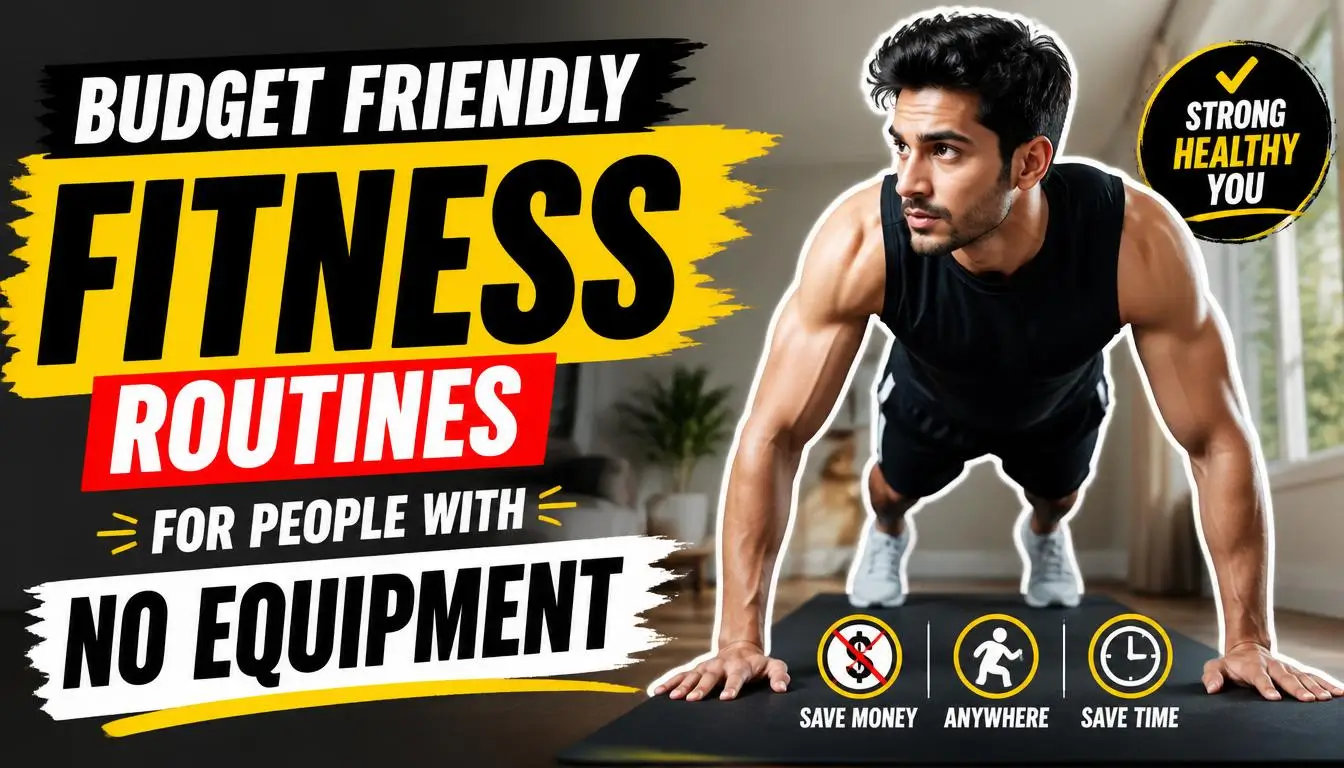
Finding genuinely useful budget friendly fitness routines for people with no equipment at home requires cutting through the advice landscape that treats “no equipment” as a temporary inconvenience on the way to purchasing a proper home gym setup. For a significant portion of people, no equipment is not a transitional state. It is the permanent condition of a budget that has higher priorities than fitness gear, a living space that has no room for equipment even if the budget existed, or a deliberate choice to build a fitness practice that doesn’t depend on owning things. All of these are completely valid starting points, and the fitness available from them is more substantial and more progressive than most people without equipment believe before they’ve actually tried to access it.
Understand What No Equipment Training Can and Cannot Do
Before any specific routine lands usefully, an honest assessment of what training without equipment genuinely achieves and where its limitations are creates more realistic expectations and better long-term adherence than promising results that require conditions the training doesn’t provide.
No equipment bodyweight training covers the fundamental movement patterns of human fitness comprehensively with one significant exception. Squats, lunges, and their variations cover lower body pushing patterns. Push-up variations cover upper body pushing patterns. Hip hinges, bridges, and single-leg work cover posterior chain development. Plank and core exercise variations cover trunk stability and anti-rotation strength. The significant limitation is the pulling pattern, specifically horizontal and vertical pulling movements that develop the back musculature and biceps, which bodyweight training struggles to address without at minimum a pull-up bar or a table edge to row from. A second limitation is progressive overload at the upper end of the strength continuum, where adding resistance requires creativity rather than simply adding weight to a barbell. Both limitations are manageable and have genuine solutions within the no-equipment constraint. Neither limitation prevents building a genuinely strong, fit, and healthy body from a starting point of no equipment and no gym access.
1. Master the Foundational Five Movements Before Adding Any Complexity
The most common mistake beginners make with no-equipment training is seeking variety and complexity before mastering the foundational movements that produce most of the available fitness adaptation. Mastery of five basic movements produces more fitness than rotation through twenty poorly executed ones.
The foundational five are the squat, the push-up, the hip hinge, the plank, and the lunge. Each of these represents a fundamental human movement pattern that the body is designed to perform and that builds strength, stability, and coordination when trained consistently. The squat trains the quadriceps, glutes, and hip complex through the most fundamental lower body movement pattern. The push-up trains the chest, shoulders, and triceps through the upper body pushing pattern. The hip hinge, specifically the single-leg deadlift or the glute bridge, trains the glutes and hamstrings through the posterior chain pattern. The plank trains the deep core stability system that supports every other movement. The lunge trains single-leg strength and balance that bilateral squats don’t develop. Spending the first four to six weeks of no-equipment training on these five movements exclusively builds the movement quality foundation that makes every subsequent progression effective rather than sloppy.
2. Build a Progressive Bodyweight Squat Program
The squat is the most trainable movement available without equipment because it has more genuine progression options than any other bodyweight exercise, ranging from beginner-accessible to genuinely challenging for advanced trainees, all without requiring a single piece of equipment.
The squat progression that produces continuous adaptation across months of training moves through identifiable stages. Beginners start with box squats to a chair seat, which provides a depth target and a confidence-building endpoint, at sets of ten to fifteen repetitions. As this becomes comfortable, full-depth bodyweight squats replace box squats with progressively deeper range of motion. Pause squats with a three to five second hold at the bottom increase the challenge without adding resistance. Tempo squats with a four-second lowering phase produce significantly more muscle stimulus than regular-speed squats at equivalent repetition counts. Bulgarian split squats with the rear foot elevated on a chair or bed introduce single-leg loading that approaches the stimulus of weighted squats. Pistol squat progressions, including assisted pistols holding a door frame and negative pistols lowering slowly on one leg, represent the upper end of bodyweight squat difficulty that challenges genuinely advanced trainees. This progression takes six to twelve months to move through completely, which means the squat alone provides a year of progressive strength training without any equipment.
3. Progress Push-Ups Through Every Available Variation
Push-ups are simultaneously the most accessible upper body exercise for beginners and the most underestimated upper body exercise for experienced trainees, and the gap between these two perceptions is bridged by understanding and applying the full push-up progression rather than treating the standard version as the end point.
The push-up progression that provides continuous challenge begins with incline push-ups with hands elevated on a wall or countertop for people who cannot yet perform standard push-ups with full control. Knee push-ups provide a second beginner entry point with less incline. Standard push-ups with hands at chest width and full plank body position are the baseline from which progression continues. Wide-grip push-ups emphasize the chest more broadly. Close-grip push-ups with hands narrower than shoulder width shift emphasis to the triceps. Archer push-ups load one arm more heavily by extending the opposite arm to the side. Decline push-ups with feet elevated on a chair shift loading toward the upper chest and anterior shoulders. Pike push-ups with hips elevated high train the shoulders in a movement pattern approaching an overhead press. Pseudo planche push-ups with hands beside the hips and forward lean produce the most advanced push-up stimulus available short of full planche training. One-arm push-up progressions represent the pinnacle of bodyweight pushing strength and require months of preparatory work through the preceding progressions before becoming accessible.
4. Address the Pulling Pattern With Furniture and Environment
The pulling pattern is no-equipment training’s genuine weak point, and addressing it requires either accepting the limitation or finding creative solutions within the home environment that don’t require purchasing equipment.
Table rows, performed lying under a sturdy dining table and pulling the chest to the table edge, are the most widely accessible pulling exercise available without equipment and genuinely train the back musculature when performed with appropriate body position and full range of motion. The table must be sturdy enough to bear your body weight without tipping, which rules out lightweight folding tables but works with most solid dining furniture. Door frame rows performed by gripping a door frame and leaning back to a angle that matches current pulling capacity, then pulling the chest to the frame, work similarly. Towel rows using a knotted towel over a closed door follow the same pulling principle. Anywhere a horizontal bar exists in the environment, playground equipment, sturdy low branches, parking garage beams, provides a pull-up opportunity that deserves recognition as part of the no-equipment training environment even when it requires leaving the house. If a single investment is to be made in the context of no-equipment training, a doorframe pull-up bar at fifteen to thirty dollars addresses the pulling limitation more completely than any other single purchase.
5. Build a Weekly Training Structure Rather Than Random Workouts
Random workout selection produces random results in no-equipment training just as it does in any other training context. A simple weekly structure that distributes training stimulus, recovery, and movement variety across seven days produces more consistent adaptation than selecting whatever seems appealing on any given day.
A three-day full-body structure works well for beginners and intermediate trainees because it provides sufficient frequency for each movement pattern while allowing adequate recovery between sessions. Day one focuses on squat and push-up patterns with core supplementary work. Day three focuses on hip hinge, lunge, and pulling pattern work with cardiovascular supplementary work. Day five combines all patterns at moderate volume with an emphasis on movement quality over quantity. Days two, four, six, and seven contain either rest, light walking, or the mobility and flexibility work that complements the strength training days. A four-day upper and lower split works better for more advanced trainees who need more volume per session to continue progressing. Upper days contain push-up progressions, pulling pattern work, and shoulder exercises. Lower days contain squat and hinge progressions with single-leg work and core training. Writing this structure on a simple calendar rather than keeping it as a mental plan converts intention into a commitment with a visual record of adherence.
6. Use Cardiovascular Training That Requires No Equipment and No Space
Cardiovascular fitness without equipment in a small space is a specific challenge that has more solutions than most people realize before exploring the options beyond running, which requires outdoor space and appropriate weather.
Jumping jacks are the most accessible cardiovascular exercise available and can be performed in a space the size of a yoga mat at any intensity from light warm-up to genuinely breathless high-intensity work. High knees running in place provide cardiovascular stimulus equivalent to slow jogging without requiring any horizontal space. Burpees in their full form combine a push-up, a plank, a jump, and a reach into one exercise that simultaneously addresses cardiovascular fitness and full-body strength in the highest caloric expenditure per minute of any floor-based movement. Mountain climbers provide cardiovascular demand in a plank position that combines core stability with heart rate elevation. Shadow boxing produces meaningful cardiovascular training with genuine skill development, requires no space beyond arm’s reach in all directions, and provides the kind of varied engagement that pure calisthenics sometimes lacks. The Tabata protocol applied to any of these movements, twenty seconds of maximum effort followed by ten seconds of rest repeated eight times for a four-minute total, produces cardiovascular adaptation comparable to much longer moderate-intensity sessions and fits within even the most compressed available fitness window.
7. Develop Core Strength Beyond Basic Planks
Core training without equipment contains far more variety and progressive challenge than the standard advice to do planks and crunches suggests, and developing it fully produces the trunk stability that improves every other movement in the no-equipment training toolkit.
The core progression moves through several stages of increasing challenge. Diaphragmatic breathing and pelvic floor engagement represent the foundational layer that most people skip and that forms the basis for everything above it. Dead bugs, lying on the back with arms and legs extended and lowering opposite limbs toward the floor while maintaining a neutral spine, train the deep core stability system in the anti-extension pattern that sport and daily life require. Bird dogs, performed from a hands and knees position by extending opposite arm and leg, train the anti-rotation and spinal stability functions that protect the back during loaded movement. Hollow body holds, lying on the back with the lower back pressed to the floor and arms and legs extended at a low angle, are among the most demanding core exercises available without equipment and represent the foundation of gymnastic strength training. Ab wheel rollouts performed from the knees using a towel on a smooth floor rather than an actual ab wheel approximate the rollout stimulus at zero equipment cost. L-sit progressions from a chair seat or from the floor build the hip flexor and core strength that translates to genuine functional capacity.
8. Apply Progressive Overload Without Adding Weight
Progressive overload, the gradual increase of training stimulus over time that drives adaptation, is the principle that makes any fitness program produce results rather than maintaining the same fitness level indefinitely. Without weights, it requires application through variables other than load.
Volume progression involves adding repetitions or sets to existing exercises as they become manageable at current levels. Moving from three sets of ten squats to three sets of fifteen before advancing to a harder variation is volume progression. Density progression involves performing the same total work in less time by reducing rest periods between sets. Tempo progression involves slowing the eccentric, lowering, phase of any movement to increase time under tension. Range of motion progression involves accessing deeper or fuller ranges of movement as mobility improves. Variation progression involves advancing to harder exercise variations as current variations become consistently manageable. Frequency progression involves adding a training day to the weekly structure as recovery capacity improves. All of these progression methods produce genuine adaptation without adding any equipment, and cycling through them systematically prevents the plateau that occurs when volume is the only progression method applied to training that has no obvious load progression available.
9. Build Flexibility and Mobility Into Every Training Week
Flexibility and mobility work requires no equipment, no dedicated space beyond a mat or carpeted area, and no experience beyond following clear instruction, yet it is consistently the most neglected component of no-equipment home training and the one whose absence is most directly felt in everyday quality of movement.
A daily ten-minute mobility routine performed in the morning or evening addresses the specific areas that sedentary modern life compresses: hip flexors tightened from prolonged sitting, thoracic spine stiffened from screen posture, ankle dorsiflexion restricted from shoe-wearing, and hamstrings shortened from the combination of sitting and insufficient hip hinge training. The specific exercises that address these areas most efficiently include couch stretch for hip flexors, thoracic rotation from a side-lying position, knee-to-wall ankle mobility drill, and standing or seated forward fold for hamstrings. Yoga with Adriene on YouTube provides completely free yoga and mobility content across hundreds of videos ranging from seven to sixty minutes that guides this work with quality instruction at no cost. GMB Fitness offers free mobility content specifically designed to complement strength training in ways that general yoga doesn’t always address. Building this work into the weekly schedule as a non-negotiable component rather than optional supplementary work produces movement quality improvement that makes every strength exercise safer and more effective.
10. Use Free Online Resources Strategically Rather Than Randomly
The internet contains more free no-equipment fitness content than any person could consume in a lifetime, which creates a specific problem for people without equipment who need structure rather than infinite choice. Strategic selection of two or three high-quality free resources and consistent use of them produces dramatically better results than random consumption of whatever appears in search results.
YouTube channels worth bookmarking and returning to consistently include Calistenics Movement for progressive bodyweight strength programming that takes trainees from beginner through advanced without equipment, Sydney Cummings Houdyshell for professionally programmed workouts across multiple formats with clear instruction and genuine progression, Heather Robertson for no-equipment workout variety within structured monthly programs that provide the weekly template that random video selection doesn’t, and FitnessFAQs for the most scientifically grounded calisthenics content available on the platform. Reddit communities including r/bodyweightfitness provide the most comprehensive community-sourced no-equipment programming available online, specifically the Recommended Routine pinned in the community which is a genuinely well-designed beginner-to-intermediate program that thousands of people have followed with documented results. The key principle is choosing one structured program from these resources and following it for a minimum of twelve weeks before evaluating whether it’s working rather than sampling multiple resources simultaneously in a way that produces variety but no progressive structure.
Frequently Asked Questions
Can you get genuinely fit with no equipment at home?
Yes, with the specific understanding that fitness means comprehensive physical health including strength, cardiovascular capacity, mobility, and body composition rather than maximum strength relative to people using heavy barbells. No-equipment training builds genuine strength through advanced bodyweight progressions, develops cardiovascular fitness through high-intensity interval formats, improves mobility through consistent flexibility work, and supports healthy body composition through the caloric demand of compound bodyweight movements. The people who achieve genuinely impressive fitness without equipment are more common than the equipment-centric fitness industry’s messaging suggests.
What is the single best no-equipment exercise for overall fitness?
The burpee produces the broadest spectrum of fitness benefit of any single no-equipment exercise, combining cardiovascular demand, upper body pushing strength, core stability, and lower body explosive power in one movement performed in a floor space the size of a yoga mat. It requires no instruction beyond basic demonstration, scales from beginner to advanced through pace and volume manipulation, and produces measurable cardiovascular adaptation when performed in interval formats. For pure strength development, the push-up is the better single-exercise answer because of its progression range and upper body development potential.
How many days per week should beginners train with no equipment?
Three days per week with rest or light walking on alternate days is the most appropriate starting frequency for beginners because it provides sufficient stimulus for adaptation while allowing the recovery time that beginners need more than experienced trainees. Daily training at very low volume, specifically five to ten minutes of light movement, is also appropriate for beginners and produces habit formation benefits that three-day programming doesn’t. The combination of three structured strength sessions and daily light movement represents the optimal starting approach for most beginners without equipment.
How do you track progress without equipment to measure?
Track the number of repetitions performed at each exercise variation before advancing to the next progression level, the time required to complete a predetermined circuit as a density metric, the depth and quality of movement as a mobility metric visible in video self-recording, and the subjective ease of movements that were previously challenging as a strength and coordination indicator. Before and after video recorded monthly provides the most comprehensive progress documentation for no-equipment trainees because it captures movement quality improvements that repetition counts don’t measure and body composition changes that scale weight doesn’t accurately reflect.
Is no-equipment training appropriate for weight loss?
No-equipment training contributes to weight loss through the caloric expenditure of exercise sessions and the metabolic rate increase from muscle development, but nutrition produces a larger and more direct effect on weight loss than exercise in almost all research contexts. No-equipment training combined with appropriate nutrition produces meaningful weight loss. No-equipment training without nutritional change produces muscle development and fitness improvement that may or may not produce scale weight loss depending on the individual’s starting point and the degree of muscle gained alongside fat lost. Both outcomes are positive and worth pursuing regardless of scale response.
Conclusion
No equipment is not a barrier to genuine fitness. It is a constraint that focuses the training on what the human body can do with itself, which turns out to be quite a lot when approached progressively and consistently over months rather than days. The people who build the most impressive no-equipment fitness aren’t the ones who eventually bought gear. They’re the ones who stayed with the progressions long enough to discover that the progressions kept going further than they expected. Where are you starting from, and which of the foundational five movements feels most accessible to begin with?