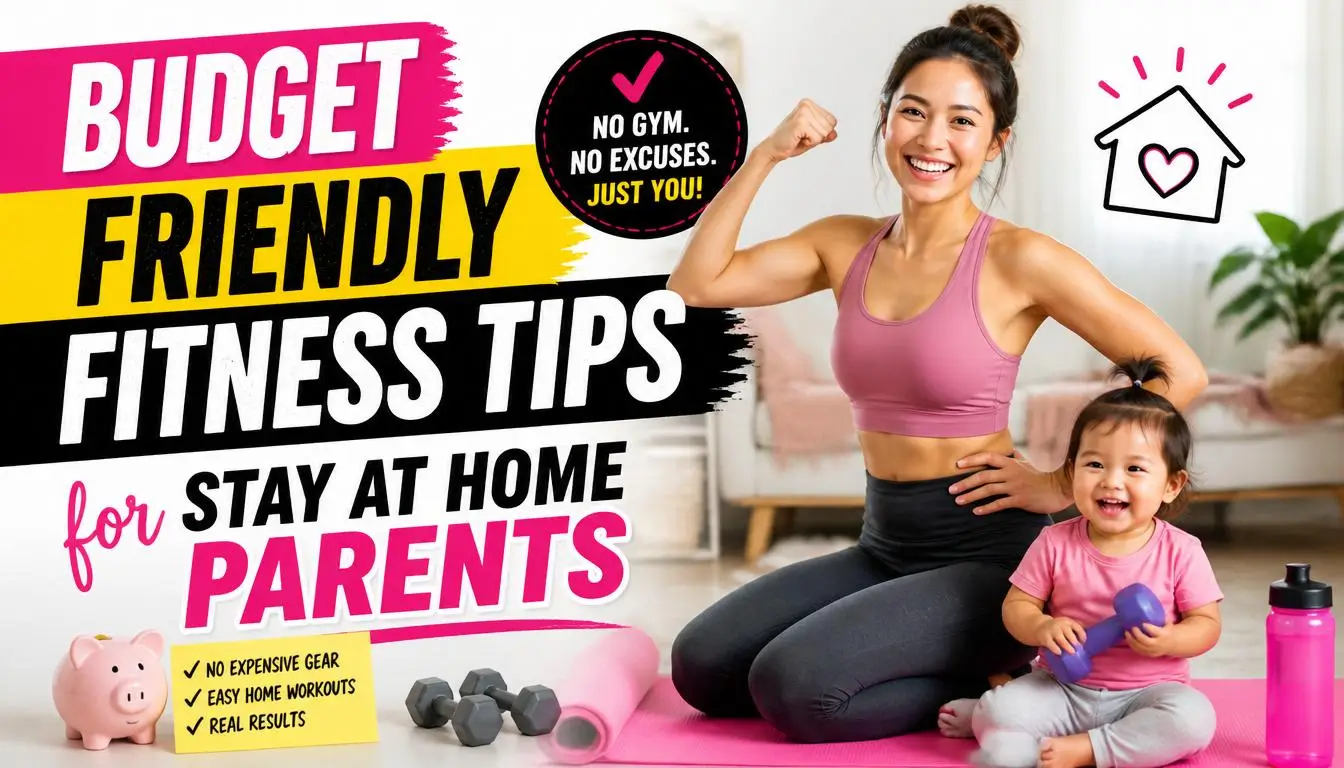
Finding genuinely useful budget friendly fitness tips for stay at home parents requires cutting through advice written by people who apparently have access to a gym, a babysitter, two uninterrupted hours, and a budget that accommodates a Peloton. Stay at home parents have none of these things on most days and all of them on exactly zero days per week with any predictability. The fitness challenge of staying home with children is not primarily a motivation problem or a knowledge problem. It is a logistics problem compounded by a budget problem compounded by the specific exhaustion of a job that has no clock-out time and no sick days and no performance reviews that tell you you’re doing well. The strategies that actually work for this specific situation look nothing like standard fitness advice, and that’s exactly what this list addresses.
Understand What Fitness Actually Means in This Season
Before any exercise tip lands usefully, the most important reframe for stay at home parents is an honest recalibration of what fitness means during a season defined by severe time scarcity, unpredictable schedules, and a body running on disrupted sleep and irregular nutrition.
Fitness during the stay at home parent season is not optimization. It is maintenance and mental health management dressed in exercise clothing. The goal is not peak performance, progressive overload toward a specific physique goal, or training for an event. The goal is moving enough to feel like yourself, managing the stress accumulation that full-time caregiving produces, maintaining enough strength to do the physical work of parenting without injury, and keeping a thread of personal identity alive through something that belongs to you rather than to your role as a caregiver. Parents who approach stay at home fitness with these goals rather than the goals they had before children consistently report better adherence, less guilt about imperfect sessions, and more genuine satisfaction with their fitness life than those who measure themselves against pre-child standards that no longer reflect their actual life circumstances.
1. Use Nap Time as Your Primary Fitness Window Without Burning It Entirely on Exercise
Nap time is the stay at home parent’s most precious resource and the one most aggressively competed for by every unfinished task, every personal need, and every fitness goal simultaneously. Burning the entire nap time window on exercise every day is not a sustainable strategy because it leaves no room for the rest and recovery that parents genuinely need.
The most effective approach is splitting nap time deliberately rather than defaulting entirely to either exercise or rest. A forty-five minute nap window might contain twenty minutes of exercise followed by twenty-five minutes of lying down with eyes closed even without full sleep. A ninety minute nap window might contain a thirty minute workout followed by thirty minutes of genuine rest followed by thirty minutes of personal time for something that isn’t exercise or caregiving. This splitting approach serves more of the competing needs simultaneously than the all-or-nothing approach, which produces either fitness at the cost of rest or rest at the cost of fitness in a way that always leaves one need unmet. The MommaStrong app and Sydney Cummings Houdyshell on YouTube both offer free and low-cost workouts in twenty to thirty minute formats specifically designed for the nap time window, requiring no equipment and minimal space.
2. Build Movement Into Caregiving Activities Rather Than Around Them
The most underused fitness resource available to a stay at home parent is the caregiving activity itself, which contains far more movement opportunity than most parents consciously access because they’re focused on the caregiving rather than the movement it contains.
Walking to the park instead of driving when the distance allows. Doing walking lunges down the hallway while a toddler follows as a game. Carrying a baby in a structured carrier during household tasks rather than using a bouncer, which adds meaningful resistance to every movement performed while wearing it. Doing calf raises while standing at the kitchen counter during meal preparation. Doing wall sits while supervising bath time. Performing bodyweight squats during commercial breaks if television is part of the children’s routine. Doing push-ups off the kitchen counter while waiting for food to heat. None of these are real workouts in the structured sense and all of them accumulate to meaningful movement volume across a full day. Research on non-exercise activity thermogenesis, the movement that happens outside of formal exercise sessions, consistently shows it contributes as much or more to long-term health outcomes as structured exercise for people whose lifestyle makes formal sessions infrequent.
3. Create a Free Home Workout System That Requires Zero Equipment
Equipment purchase is where most home fitness intentions go to die, specifically because the equipment gets bought, used enthusiastically for two weeks, and then becomes an expensive obstacle course in the spare room. Budget stay at home parent fitness works best when the equipment requirement is exactly zero.
Bodyweight training covers every fundamental movement pattern that structured fitness requires. Squats and their variations train the lower body. Push-up variations from standard to knee to elevated train the pushing pattern. Rows using a sturdy table edge train the pulling pattern. Hip hinges and single-leg deadlifts train the posterior chain. Planks and their variations train core stability. YouTube provides more free bodyweight workout content than any person could use in a lifetime, and the channels worth bookmarking for stay at home parents specifically include Sydney Cummings Houdyshell, whose free workouts are professionally programmed and consistently well-cued, MommaStrong, which designs specifically for postpartum and parenting bodies, and Heather Robertson, whose no-equipment programs are structured progressively enough to produce real fitness adaptation over time. The absence of equipment eliminates the setup time that is often the actual barrier between a parent and a workout in the narrow windows available to them.
4. Invest in One Resistance Band Set and Nothing Else
If any equipment purchase is going to be made, a single set of loop resistance bands representing the entire fitness budget is the highest return investment available for a stay at home parent working within a genuine budget constraint.
A set of five loop resistance bands in progressive resistances costs between ten and twenty-five dollars from Fit Simplify, WOD Nation, or Perform Better and provides the resistance training variety of a full gym’s worth of machines at a fraction of the cost, in a form factor that stores in a kitchen drawer and requires no dedicated space. Banded exercises cover hip abduction for glute development, banded squats for lower body strength, pull-aparts for upper back and shoulder health, banded push-ups for chest and triceps, and bicep curls and overhead press variations for arm strength. The resistance bands also serve a specific stay at home parent function that free weights don’t: they’re safe around children. A toddler encountering a resistance band during a parent’s workout is annoying. A toddler encountering a dumbbell or kettlebell during a parent’s workout is dangerous. The safety dimension of resistance bands in a home environment with mobile children is genuinely underappreciated as a practical fitness consideration.
5. Use Children as Resistance in Structured Play Workouts
Children are both the primary obstacle to stay at home parent fitness and, when approached creatively, one of the most engaging fitness tools available, which is a reframe that sounds fanciful until you’ve actually tried it and discovered that a toddler finds it genuinely hilarious to be incorporated into a parent’s workout.
Baby presses, lying on your back and pressing a young baby overhead in a slow, controlled movement, provide both pressing exercise and the face-to-face interaction that promotes infant attachment. Toddler squats where the child sits on a parent’s lap or shoulders during a squat provide meaningful resistance that increases as the child grows. Piggyback squats, bear crawl races, wheelbarrow walks, and carrying children up and down stairs all provide genuine resistance training stimulus in a play context that the child experiences as engagement rather than inconvenience. The workout-as-play approach also solves the childcare problem by definition because the child is the workout rather than the barrier to it. GoNoodle, a free movement app designed for children, provides structured movement breaks that a parent can genuinely participate in alongside a child rather than supervising from the couch, which provides mild cardiovascular benefit while meeting the child’s movement needs simultaneously.
6. Walk More Than You Think Is Necessary as a Fitness Strategy
Walking is consistently undervalued as a fitness tool by people who have access to more intense options and consistently underused by stay at home parents who have access to it constantly but don’t count it as exercise because it doesn’t feel like exercise in the traditional sense.
A thirty to forty-five minute brisk walk with a stroller provides meaningful cardiovascular stimulus, fresh air and mood regulation through exposure to natural light, a change of environment that benefits both parent and child, and the proprioceptive input that children in strollers receive from varied terrain. Hilly routes increase the cardiovascular demand without requiring any additional equipment or time. Walking with a child in a carrier rather than a stroller adds significant resistance that scales naturally as the child grows. The research on walking as a health intervention is among the most robust in exercise science, consistently showing meaningful improvements in cardiovascular health, mental health, insulin sensitivity, and all-cause mortality risk from walking alone at volumes achievable through daily stroller walks. Parents who walk thirty minutes daily with their children are doing more for their long-term health than parents who attempt intense workout sessions three times per week and fail consistently due to schedule disruption.
7. Access Free Community Fitness Resources Before Buying Anything
Most communities contain fitness resources that stay at home parents don’t know about or don’t think of as accessible to them, and accessing these before spending any money on equipment or subscriptions is both financially sensible and socially valuable in a season that can be genuinely isolating.
Public parks with outdoor fitness equipment exist in most medium to large cities and provide free access to pull-up bars, parallel bars, and various resistance stations that cover a complete strength training workout. Community center and YMCA programs frequently offer sliding-scale membership based on household income that brings costs well below standard rates for families with limited income during a stay-at-home period. Many YMCAs offer family memberships that include childcare in their onsite childcare facility, which effectively provides the gym access and childcare solution simultaneously at a single membership cost that is often lower than a gym membership plus separate childcare combined. Library systems in most communities offer free fitness DVD lending, free fitness app access through Libby and Hoopla, and some branches host free fitness classes specifically for parents with young children. Facebook Marketplace and local Buy Nothing groups are excellent sources for free or nearly free fitness equipment including resistance bands, dumbbells, yoga mats, and exercise balls that other parents have outgrown or upgraded from.
8. Incorporate Flexibility and Mobility Work During Low-Energy Windows
Stay at home parents have high-energy windows where structured exercise is possible and low-energy windows where it genuinely isn’t, and ignoring the low-energy windows entirely as fitness opportunities wastes time that could produce genuine physical benefit without requiring the energy reserves that a workout demands.
Stretching and mobility work performed during a nursing session, a child’s quiet play, or the evening after children are in bed requires minimal energy, produces genuine physical benefit for the postural issues that caregiving creates, and can be done lying on the floor or sitting against the couch without changing clothes or creating a dedicated exercise space. The specific areas most chronically tight in stay at home parents reflect the postures caregiving requires: hip flexors from prolonged sitting and carrying, chest and anterior shoulder from feeding and device use, thoracic spine from hunching over small children, and calves from standing on hard floors. Ten minutes of targeted stretching for these areas before bed costs almost nothing in energy or time and produces cumulative mobility improvement over weeks that meaningfully reduces the chronic discomfort that many stay at home parents normalize as an unavoidable part of the job. Yoga with Adriene on YouTube provides completely free mobility and yoga content in sessions ranging from seven to sixty minutes that can be matched to whatever energy and time window is available.
9. Make Sleep and Nutrition the Foundation of Your Fitness Strategy
This is the fitness tip that no fitness brand will ever sell because it doesn’t require purchasing anything, and it is simultaneously the most impactful intervention available for a stay at home parent whose fitness goals include having the energy to exercise consistently rather than exhaustedly and occasionally.
Sleep deprivation impairs muscle protein synthesis, elevates cortisol which promotes fat storage and muscle breakdown, reduces the motivation and cognitive function that make exercise initiation possible, and produces the sugar and carbohydrate cravings that work against whatever nutritional goals accompany a fitness strategy. Prioritizing sleep above exercise when the choice is forced is the physiologically correct decision for a stay at home parent whose sleep is already fragmented, because the workout’s benefits are largely negated by the metabolic environment that sleep deprivation creates. Eating enough protein throughout the day, approximately 0.7 to 1 gram per pound of body weight, supports muscle retention and provides the satiety that prevents the energy dips that derail both exercise intentions and nutritional choices. Preparing one protein-rich food in bulk once per week, specifically hard-boiled eggs, a batch of cooked chicken, or a pot of legumes, ensures that protein is accessible during the rushed and chaotic meal times that stay at home parenting produces rather than defaulting to whatever is fastest.
10. Lower the Barrier to Every Workout Until It’s Almost Zero
The most common reason stay at home parents skip workouts isn’t laziness or lack of motivation. It’s the activation energy required to begin when every moment of available time has seventeen competing claims on it and the mental bandwidth to make decisions about exercise is genuinely depleted by the time the window arrives.
Lower every barrier to starting to the point where beginning a workout requires less decision-making energy than skipping it does. Sleep in workout clothes if the morning window is your target time so that getting dressed is already complete when you wake. Keep the yoga mat permanently unrolled in a corner of the living room rather than stored so that beginning a workout doesn’t require setup. Save three or four specific YouTube workouts as browser bookmarks that open immediately rather than requiring a search when you have seventeen minutes and limited mental energy to spend on choosing content. Write tomorrow’s workout on a sticky note tonight rather than deciding what to do when the window arrives. Set a single recurring phone alarm labeled with the workout rather than relying on remembering when the window exists. The research on habit formation consistently shows that reducing the steps between intention and action is more effective at increasing behavior consistency than increasing motivation, which is a finding with specific and practical application to a stay at home parent whose motivation is adequate and whose barriers are the actual problem.
Frequently Asked Questions
What are the most realistic fitness goals for stay at home parents on a tight budget?
Three to four movement sessions per week averaging twenty to thirty minutes each is a realistic and genuinely achievable target for most stay at home parents working within real schedule constraints. Measured against the public health recommendation of 150 minutes of moderate activity per week, this target meets or exceeds the threshold that produces meaningful health benefit without requiring the daily consistency that nap schedules and child sleep patterns don’t reliably support. Progress measured in months rather than weeks reflects the actual adaptation timeline available within these constraints.
How do stay at home parents find time to exercise with young children at home?
The most reliable time windows are nap time for children who nap predictably, early morning before the household wakes for parents whose chronotype and infant sleep situation allow it, and evenings after children are in bed for parents whose own sleep needs don’t compete with that window. Baby-inclusive and child-alongside exercise during awake time fills the gaps when dedicated windows aren’t available. The combination of these approaches rather than reliance on any single window produces more consistent movement volume than waiting for the perfect uninterrupted block that may never arrive.
What is the best free fitness resource for stay at home parents?
YouTube provides the most comprehensive and highest-quality free fitness content available, with channels including Sydney Cummings Houdyshell, MommaStrong, Heather Robertson, and Yoga with Adriene collectively covering strength training, postpartum rehabilitation, cardiovascular fitness, and flexibility without any subscription cost. The library system’s digital lending through Libby and Hoopla provides free access to fitness apps and video content for cardholders. Public parks with outdoor equipment cover strength training needs for parents who can get outside during the day.
How do stay at home parents stay motivated when exhausted and isolated?
Redefine the success metric from performance outcomes to consistency and self-compassion metrics. A ten-minute walk counts. A fifteen-minute stretch counts. Showing up imperfectly and incompletely consistently beats showing up perfectly and occasionally by every measure of long-term fitness outcome. Social accountability through a free fitness Facebook group for parents, a walking buddy from the neighborhood, or a shared fitness challenge with a friend in a similar parenting season provides external structure that internal motivation cannot reliably generate during the depleted periods that stay at home parenting regularly produces.
Is it worth paying for a fitness app as a stay at home parent on a budget?
Only if the free resources have been genuinely exhausted first and the specific structure or content of the paid option provides something demonstrably unavailable for free. YouTube’s free content is extensive enough that most stay at home parents on genuine budget constraints should not need a paid app. MommaStrong at approximately ten dollars per month is the one paid option most worth considering specifically for postpartum parents because its combination of clinical postpartum rehabilitation knowledge and parent-specific scheduling design is not replicated with the same quality in free resources. Everything else is available free in sufficient quality for most stay at home parent fitness needs.
Conclusion
The stay at home parent fitness journey is less about finding motivation and more about finding the approach that fits the actual life rather than the ideal one, and the two look genuinely different in ways that standard fitness advice never acknowledges. Every workout completed in a window that barely existed is a genuine achievement, and the cumulative effect of those imperfect, interrupted, shorter-than-planned sessions is a fitness life that persists through one of the most physically and logistically demanding seasons a person can live through. What’s the biggest barrier standing between you and the movement you know would make you feel better, and which of these strategies speaks most directly to it?